


- In 2026, zoning reform is shifting from isolated bylaw changes to broader system redesign by pairing code updates with implementation tools, clearer rules, and faster approvals.
- North American governments are expanding housing capacity through missing-middle zoning, transit-oriented growth, and rolling back certain constraints like parking mandates.
- Some higher-level governments, including British Columbia and California, are compelling municipalities to reform their zoning laws.
Frustration with the slow pace of addressing housing shortages and building permitting times has reached such a height that zoning reform has permeated the public consciousness more than the average dry policy news. For example, entrepreneur and best-selling author Peter Diamandis, who’s normally obsessed with high technology like autonomous aircraft and humanoid robots, recently called zoning reform a “national priority” on his Metatrends blog.
The urgency is not lost on the biggest municipalities in North America, many of which have passed zoning reform in the last year or so. But there’s more to zoning reform that just passing bylaws.
“The zoning code is never the only gatekeeper,” says Wayne Childs, Director of Strategic Enterprise, International Code Council (ICC). “Infrastructure permitting, departmental silos, and the lack of regulatory certainty, where entitlements can be revoked or conditions changed mid-project, will kill projects that the land use code allows. Cities tend to focus on passing reform without addressing the administrative systems that determine whether it actually functions.”
Fortunately, the governments setting the zoning reform trends in 2026 may be wise to Childs’ warning. Their initiatives are less about one-off rule changes, and more about system redesign. That’s taking the form of code changes combined with practical implementation tools, cities replacing case-by-case decisions with citywide rules, and in some cases, higher-level governments mandating certain zoning reform.
Legacy constraints are dropping; housing types are diversifying. These are the zoning reform trends to watch in 2026.

Modern "missing middle" housing in Vancouver, British Columbia, where provincial Bill 25 establishes the SSMUH (small-scale, multi-unit housing) framework.
1. Higher-level governments requiring local zoning reform
A clear trend for some North American cites in 2026 stems from bills passed in larger jurisdictions in 2025. Some states or provinces passed laws requiring their constituent cities to update zoning laws.
For example, British Columbia, Canada’s Bill 25 requires its cities to update zoning by June 30, 2026 to allow more housing units per lot and remove minimum on-site parking requirements near Frequent Transit Areas and to allow more multi-unit housing development. The province says municipalities play an important role through housing plans and zoning bylaws, but that it has the authority to set housing targets, require annual reporting, appoint advisers, issue directives, and issue an Order in Council if a municipality fails in these directives.
In response to this, cities like North Vancouver have set timelines to gather community feedback and change zoning bylaws before the deadline.
Meanwhile in California, state lawmakers’ Senate Bill 79, the Abundant and Affordable Homes Near Transit Act, goes into effect July 1, 2026, with the intention of creating affordable housing supply closer to transit, jobs, and services. Californian cities must adapt to SB 79’s requirements or risk losing state funding and certain control over its zoning. San Francisco’s response, its Family Zoning Plan, took effect in January 2026. It eases building restrictions in certain neighborhoods that have seen limited housing built in recent decades due to zoning rules.
Los Angeles has answered with a proposed phased implementation of SB 79 by 2030, with some immediate expansion to its Corridor Transition Program, which incentivizes residences around transit stations.
This trend shows that there more than one way to enact zoning reform, and that inaction around zoning reform is getting harder to defend both politically and legally.
2) “Missing middle” has moved from theory to code
British Columbia’s top-down approach also includes its SSMUH (small-scale, multi-unit housing) framework that illustrates the trend of “missing-middle housing” moving from city planner parlance to the text of zoning bylaws in 2026. Missing-middle housing describes the swath of medium-density dwellings such as duplexes, fourplexes, townhouses, live-work units, and others.
The SSMUH and Bill 25 require local bylaw changes for three to four units on many formerly single-family or duplex lots, and up to six units near frequent bus service. The City of Surrey’s implementation of it shows substantial changes. Nine new SSMUH zones in Surrey replaced 14 single-family zones, one semi-detached zone, four gross-density zones, and one duplex zone.
Yet not all the examples of this trend come from the top down. On March 26, 2026, the Austin, Texas City Council initiated new zoning districts for townhomes, cottage courts, small-scale multi-unit housing, and mixed-use projects. It also directed staff to make zoning code changes to better facilitate those new districts.
New York City passed City of Yes for Housing Opportunity in December 2024 and it’s picking up momentum in 2026. This plan aims to create 82,000 new homes over 15 years, including re-legalized modest apartment buildings near subway and rail stations in select low-density areas, by allowing “a little more housing in every neighborhood.” It also allows accessory dwelling units (ADUs) citywide in one- and two-family areas.

Interior rendering of the Far Nordic ADU, a pre-approved design under NYC's "ADU for You" program. Courtesy of New York City's Office of the Mayor.
3) Concentrating growth near transit and commercial corridors
Many of the 2026 zoning reforms opt not to create density everywhere all at once. Instead, there is a very clear trend toward targeted upzoning and new housing capacity in districts near transit, services, job opportunities, and other commercial activity.
NYC’s City of Yes, for example, specifically re-legalizes modest apartment buildings near transit stations, as well as housing above businesses on commercial streets in low-density districts. San Francisco’s Family Zoning Plan also focuses housing opportunities near access to public transit, parks, retail, and community facilities.
Los Angeles and British Columbia are also moving in a similar direction. L.A. City Planing’s implementation of SB 79 immediately expands Corridor Transition incentives and applicability around eligible transit stations. And SSMUH rules for British Columbia municipalities scale upward near frequent bus service.
4) Parking mandates falling by the wayside
There’s no such thing as a free lunch, nor free parking. Mandating parking with housing supply adds cost, consumes site area, and can make infill projects harder to design. With 2026’s zoning reform, many prior parking mandates are going out the window. For instance, New York’s City of Yes plan eliminates parking mandates in some areas, reduces them in others, and exempts certain other transit-oriented projects and ADUs.
The Canadian cities complying with British Columbia’s provincial Bill 25 are also significantly rolling back parking. North Vancouver says it must remove minimum on-site parking requirements within Frequent Transit Areas. And the City of Surrey will not require off-street parking or loading for the type of small-scale multi-family housing specified in Bill 25.
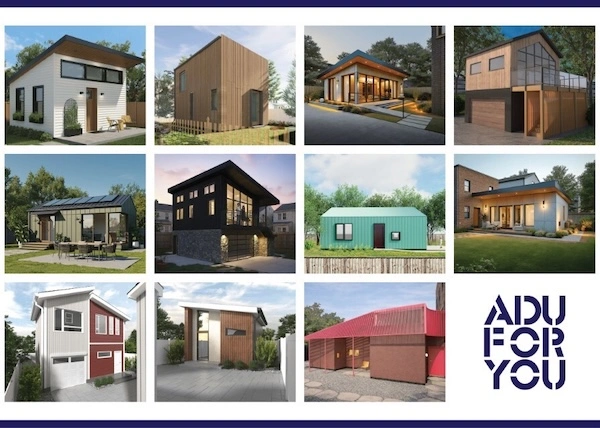
New York City's "ADU for You" program comes with implementation tools, like a guidebook and these 11 pre-approved ADU designs. Courtesy of New York City's Office of the Mayor.
5) Zoning reform packaged with implementation tools
Serious zoning reform in 2026 doesn’t always stop with policy. It the case of NYC’s “ADU for You” program, it includes a guidebook, site feasibility analysis tools, cost-estimating tools, potential financial support, and even a Pre-Approved Plan Library with 11 ADU designs meant to speed up approvals with fewer surprises.
“One of the solutions to the housing crisis can be found in our backyards, our attics, or our basements—in an Ancillary Dwelling Unit,” said New York City Mayor Zohran Mamdani. “By making it easier for New Yorkers to turn their homes into an extra place for a loved one or a little more income, we’re allowing our city to grow while keeping the character of the neighborhoods we love.”
Other US and Canadian cities are following suit by operationalizing zoning reform. Austin’s March resolution, for example, pairs new zoning districts with work on “administrative barriers.” Surrey gives property owners a zoning lookup tool and publishes clear replacement-zone tables, while Vancouver’s Official Development Plan (ODP) is built around simplified regulation, concurrent processing to save time, and maps that show where housing and facilities can go.
6) Replacing parcel-by-parcel rezonings with clearer citywide rules
British Columbia’s SSMUH framework is designed to enable more housing without needing to rezone every individual lot. As a result, the ODP that Vancouver passed in March 2026 also indicates a larger trend where cities are moving away from ad-hoc, parcel-by-parcel rezonings in favor of citywide frameworks for future land use and city-building.
“This is a defining moment for Vancouver,” said Mayor Ken Sim. “The Vancouver ODP ensures growth happens thoughtfully and in a coordinated way, so we can deliver more housing, support a strong local economy, and build complete, connected neighborhoods. It’s about making sure our city continues to meet the needs of the people who live and work here.”
Similarly, San Francisco’s Family Zoning Plan replaces older exclusionary patterns with a mapped citywide logic for placing more housing. For municipalities, this generalizing trend may be the most important one for practical zoning reform. It gives city staff, applicants, and communities a clearer picture of baseline zoning and reduces discrepancies while increasing predictability.

This rendering of San Francisco's Fisherman's Wharf neighborhood shows how the city's Family Zoning Plan will allow taller residential buildings in certain areas. Courtesy of San Francisco Planning.
Zoning reform is becoming a delivery strategy
For zoning reform to contribute to real municipal modernization, it won’t simply come with new rules. Rather, It will also come with a strategy for delivering the housing outcomes cities and their citizens’ want. That’s a major takeaway from these 2026 zoning reform trends, where forward-looking municipalities are bundling policy reform with clearer implementation tools.
Cities are also making reformed zoning rules easier to understand, easier to administer, and easier to turn into real housing. That housing increasingly represents the “missing-middle” of medium density and increasingly is placed near transit and commercial corridors, with or without mandatory parking.
City CIOs, planning and building directors, and city managers and learn build from these promising trends. Once reform is in place, it’s time to implement and manage the changes. Childs of the ICC recommends exploring digital tools to monitor the stages of community development with instant, valuable feedback.
“You can’t manage what you can’t measure,” he says. “If a city doesn’t know where applications are stalling, how long each stage takes, or which project types are abandoning the pipeline, the reform is running blind. Modern tools don’t replace good policy, they make it visible.”