


- This expert panel recommended that building departments use AI for repetitive tasks rather than treat it as a replacement for code officials.
- An ideal human-AI partnership frees staff to spend more time on communication, problem-solving, judgment, and public service.
- Trust in AI depends on transparency, local customization, and keeping experienced people in the loop.
At CALBO’s (California Building Officials) 64th Annual Business Meeting in Santa Clara, the hot topics for the week centered around the deserving themes of fire safety, wildfire preparedness, housing supply, and AI for building departments and plan reviews. With building officials under mounting pressure to do more with less, AI tools loom over them with conflicting prospects of either making their jobs easy, or worse, making their jobs disappear.
However, during “The Human-Al Partnership: Empowering Code Officials, Not Replacing Them” on April 14, the panelists from the field of building and safety emphasized that building officials neither need to make a devil’s bargain with AI by over-relying on it, nor to reject it entirely out of fear. Instead, they should feel empowered to use AI for what it does best—improving the process quality of repetitive work—while using the saved time for what people do best: establishing trust, collaborative service, facilitation, and human judgment.

San Jose City Hall, just down the street from the location of CALBO’s 64th Annual Business Meeting.
Why Human-AI Partnership Matters Now
A recurring theme during the panel discussed the demands piling on building departments from multiple angles: higher expectations (in part from legislative mandates), a larger workload, and less time to handle it. Digital tools that leverage AI to make building plan reviews and permit approvals more efficient are arriving at a time when building departments could really use the help.
The panelists maintain a healthy skepticism for extraordinary AI claims, yet recognize the value of using the right AI for the right purposes. They also recognize the tension around AI tools. “I think a lot of the uncertainty is because science is getting so close to science fiction,” says Jesse Cardoza, Building and Safety Manager/Chief Building Official, City of Irvine. “The Terminator wasn’t about a calculator. Now AI looks a lot like the stories we’ve read and seen.”
“In my previous jurisdiction, we did institute 14 automated workflows for permits,” says Pete Jackson, Lead Regulatory Engineer for UL Solutions, who also spent more than 20 years as a chief electrical inspector for the cities of New York and Bakersfield. “By doing so, we didn’t decrease oversight; we increased oversight. It didn’t result in anyone losing a job. Those people had better things to do with their time than correct a lot of application mistakes. So, we can increase the speed by decreasing errors both on the applicant’s end and on our end, and therefore do things quicker and better.”
Focus on the Sweet Spot: What AI Does Well
It’s important, however, for building departments to distinguish between different types of AI tools, to make sure a specific AI solution is mature and effective, and to use them for what they do well. The panel repeatedly touched on the different types of AI, which do things differently and have different uses: deterministic, probabilistic, and generative AI. Probabilistic AI makes predictions based on historical data, so can be very wrong about things if some of the past data is wrong. This type of AI also exhibits the “black box problem” that the panelists warned against, which occurs when the AI’s reasoning for its output is difficult to understand.
Jackson warns against using predictive AI for building-related jobs, such as design or checking for code compliance. Instead, you want deterministic AI, which gives consistently fixed outputs based on programmed rules. This kind of AI is very effective at repetitive building department task such as permit workflow automations, real-time code references, reducing errors, and screening for incomplete permit submittals.
“Incomplete submittals are where my counter spends probably 60% of its time,” Cardoza says. “We each get to decide where in the process to insert [AI]. Now’s the time to start thinking about the most effective and efficient way for your jurisdiction.”
The consistent and efficient results from deterministic AI also have downstream benefits. “For building departments, consistency equals quality,” Jackson says, “being consistent for all types of permits from all applicants. That’s something where automation can help us.”
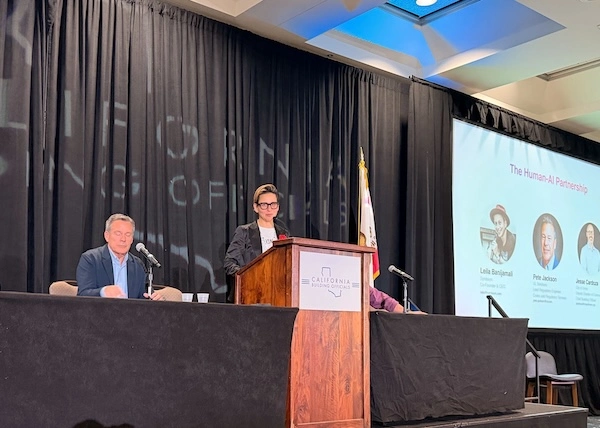
From left to right: Pete Jackson, Lead Regulatory Engineer for UL Solutions; Leila Banijamali, co-founder/CEO of Symbium; and (obscured) Jesse Cardoza, Building and Safety Manager/Chief Building Official, City of Irvine.
People Being People Helping People
Throughout the discussion, the panelists returned to the cautiously optimistic refrain that if building departments choose their AI uses wisely, that can help empower building officials to provide better service to their communities doing what humans to best: educating, making judgment calls, being a collaborative problem-solver with their constituent permit applicants, and in general facilitating people’s success.
For example, a veteran building official mentioned during the Q&A that a recent 20-minute phone call with an architect accomplished more than two time-consuming rounds of back-and-forth on a plan check. So if a building departments can save hours of review back-and-forth every week using quality AI tools, their staff can have more time for the kind of proactive, personal outreach that Cardoza says is the higher purpose for building officials.
“Hopefully our role evolves from just applying code to active problem-solving and being a facilitator to finding effective and reasonable solutions for the developers,” Cardoza says. “View your role now as being more of a value-added partner to your development community. What is it we want to give the jurisdictions we work for?”
How to Adopt AI While Maintaining Trust
Given the positive potential of AI for building departments and the necessity of choosing the right AI tool for the desired job, the panel gravitated toward the theme of trust. How do you trust that your AI solutions are reliable?
Both Jackson and Cardoza emphasized maintaining healthy human oversight. “Keep a human in the loop,” Jackson says. “Somebody in the building department has to know what’s going on and know how to apply things correctly.”
Cardoza added that when used correctly, AI will probably get it right, but to “use your knowledge, experience, and skills as a building official to sanity-check what you’re getting out of it.”
Panelists also encouraged building department staff to actively participate in shaping the AI tools that are built for them. They could do that simply by contacting the technology vendors and ask them how to participate in framing the logic of what the AI tools do and how they are trained. Insist on being part of the conversation and insist that the tools being created for building departments are auditable and transparent to avoid the black-box effect, and locally customized for specific jurisdictional needs.

Human Empowerment, Not Replacement
After its mixture of skepticism and success stories around AI for building officials, the message of this panel discussion was clear. Building departments do not need to choose between rejecting AI or surrendering to it. If municipalities stay immune to what one audience member called the “AI arms race” and not force upon building departments AI tools that are “not ready for prime time,” selective AI adoption is the right option.
As Jackson says, when it comes to building officials, “good judgment is the most critical feature to have.” Keep people at the center of the process, where the deeply human work of judgment, trust, service, and multi-disciplinary problem-solving matter most for keeping communities safe. Then leverage AI where it improves consistency, saves time, and reduces errors. That is the human-AI partnership for building departments.