


- A futurist keynote argued that command-and-control org charts are a railroad-era artifact, and that a better method pushes decisions from the center to the edge, where the people deeply understand the problems.
- One county shows the cost and the payoff: 15 separate IT departments, an 18-month fight to pass a single AI policy, and staff champions bringing their own proofs of concept to IT.
- For building departments that push AI adoption to the edge, a tech-maturity model lets reviewers earn more autonomy as an AI tool proves itself, with decision-making that continues well past deployment.
To navigate the ever-evolving landscape of the AI age, bestselling author and futurist Jonathan Brill recommends that organizations take a lesson from one of the oldest members of the animal kingdom on Earth. In his book AI and the Octopus Organization (co-written by Stephan Wunker), Brill explains that an octopus has only about a third of its neurons in its head. More than two thirds are distributed throughout its tentacles, which explore, solve problems, and act largely on their own. The tentacles, or arms, report back to the central brain after the fact. In other words, an octopus is agile “at the edges” and aligned at the center.
That’s the model that Brill advocated for business and governmental organizations during his keynote speech at the 2026 Los Angeles Digital Government Summit (LADGS). In his examples of working with the US Navy and a corporate legal department, the organizations funneled every judgment call upward, even though the people working at the edges were more than capable.
Where the "Edge" Sits in a Building Department
Most municipal building departments would recognize immediately the problem Brill described.
In a building department, the edges are at the counter and in the field. Plan reviewers, inspectors, and permit technicians hold specific knowledge such as the conditions on a parcel that have tripped up other projects, where local amendments diverge from the model code, which contractors submit clean work, or specific details about a particular applicant’s plan set. Department-wide policies can’t fully replicate those specific knowledge sets.
Many government AI rollouts match the hierarchical, command-and-control model that Brill says is becoming outdated quickly, because leadership selects a tool, mandates it department-wide, and the people actually living the workflow get less (or no) say.
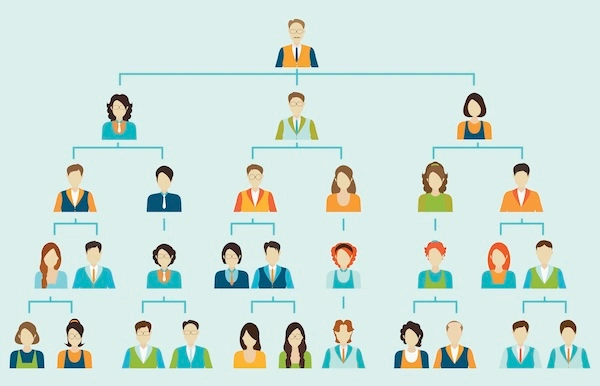
In the era of distributed intelligence, many say the traditional command-and-control org chart is outdated.
Moving Beyond Command-and-Control
In his speech, Brill pointed out that the completely top-down, command-and-control org chart comes from the railroad era of the 19th century. It was an organizational structure built for a world where only the people at the top had the full picture on which to base decisions, and everyone below existed only to execute on those top-down decisions.
However, like the neurons of an octopus, intelligence today is distributed more or less evenly throughout a whole organization, and access to AI makes that even more the case.
“Every single person in every single organization is about to get dramatically smarter as a result of AI,” Brill says. Concentrating judgment at the top of an org chart works poorly when front-line staff have powerful analytical tools.
With an octopus, the edges don’t wait for orders from the top. “The tentacles start to explore on their own,” he says. “They report out what they’ve just done. It goes from the bottom up.”
Yet the way to change a hierarchical organization is not to simply flip the old command-and-control model. Brill describes an octopus experiment with a fish behind plexiglass where one of the tentacles can sense the fist but can’t reach it. At that point, the the octopus brain intervenes, helps the tentacle with the problem, and then releases control again. Control in an octopus organization should move bottom-up or top-down, depending on where the answer actually lies.
Creating that dynamic at scale takes two things: portfolio thinking and risk balance. Brill says “portfolio thinking” judges an entire body of work rather than each case. “Bosses don’t really care what you’ve failed over the course of the year,” he says. “They care about your yearly performance across that entire portfolio.”
In risk-averse organizations, telling people not to exceed some threshold of risk usually means they take no risk at all, and as a result do not learn anything that comes from taking risk and/or occasionally failing. Brill says they should practice “risk balance” instead. “I want you to fail 5, 10, 20, 30 percent of the time to figure out where the new opportunities and innovations are,” he says.
Brill’s examples include the U.S. Navy, traditionally a very command-and-control organization. However, when it freed staff to build inside a defined, non-classified zone of its code, its IT organization massively increased its delivery over roughly 18 months. In another example, a corporate legal department automated away real tasks, yet jobs were unaffected. Instead, the demand for services and quality simply “refilled the hours they spent on other things.”

In an "octopus organization," people at the edges of the org chart make meaningful decisions and report back to the center.
One County’s Hierarchical Evolution
Brill ended by challenging everyone to push decisions from the center to the edge of organizations, so the people who really understand the problems do more of the innovating. But how does that look when a local government actually does it?
In a separate session at the 2026 LADGS—“AI One Year Later: Lessons from Implementation”—Lynn Fyhrlund, Chief Innovation Officer, San Bernardino County, described a scenario similar to Brill’s octopus analogy. San Bernardino runs 15 separate IT departments across 24,000 employees. Despite that, Fyhrlund says it tries to have “an overarching governance… but with enough autonomy in a department to do what we need to do.”
However, approving a single countywide AI policy took about 18 months, because every department had to be brought along. While that was not ideal, the process surfaced cases of bottom-up decision-making in action. Fyhrlund says staff “champions” found their own use cases, built proofs of concept, and then brought them to IT, “saying, ‘this is what I want,’ which I look at as fantastic,” he says. That is the tentacle exploring on its own and reporting back.
He also unknowingly supported Brill’s call for risk balance. Roughly half of Fyhrlund’s employees still won’t experiment with AI, in part because of risk hesitancy. “No one wants to use up a bunch of tokens and get talked to by the boss,” he says. Part of risk balance should just be the permission to experiment. Without it, the tentacles don’t explore.
Decisions Made at the Edge Gradually Earn Validation Through Trust
Sitting on the same panel as Fyhrlund, Brant Birkeland, Principal Director, AI Permitting Solutions, Archistar, described a way in which decision-makers at the edges of organizations can move forward with a measured amount of risk and scale up only when appropriate. Insomuch as those decisions add AI tools and automation to their work, the amount of autonomy granted equals the amount a tool has earned through proven performance.
Birkeland says Archistar assesses an organization before deploying. “First we try to understand,” he says, “what is the [organization’s] level of maturity in the specific context we’re trying to serve? Maturity with AI is really about trust and confidence. You can scale in maturity the more users trust and have confidence in the result.”
In this scenario, the people at an organization’s edge continually work to gather more intelligence about technology adoption. They measure performance benchmarks, pass them up to the center, and decide how good performance and confidence need to be before continuing to a higher level of automation. Control isn’t handed to the edge once, but rather it’s renegotiated as trust accumulates.
Birkeland’s ongoing AI tool lifecycle includes defining the business case, testing for accuracy, piloting, deployment, and observation. “You have to monitor those agents; make sure they’re performing correctly,” he says. A plan reviewer earns more latitude with a tool as it proves itself, and the department analyzes a live feedback loop.
Brill’s point about where applicable knowledge lives inside an organization could apply directly to building departments. In a permitting office, applicable knowledge sits at the counter, in the field, and with the people reading the plan sets.
Taking advantage of that doesn’t require reorganizing the department. It just takes determining which decisions belong at the edge and the willingness to make them.