
- Building permit delays often stem from incomplete plan sets, not just city capacity or compliance issues—triggering costly back-and-forth between applicants and reviewers.
- AI PreCheck’s Completeness Check verifies that required documents, drawings, and metadata are present and consistent before a submission moves to compliance review.
- Once a submission is ready for review, reviewers gain predictability: Intake reflects real, assessable work, so reviewers’ workloads stop being a guessing game.
There’s massive pressure on municipal planning and building departments to speed up the permitting process, but one reason for backlogs and delays is often overlooked.
According to a December 2025 survey from the International Code Council (ICC) of building, planning, and permitting professionals across 41 states in the US, one major factor causing delays is that applicants aren’t submitting all necessary information in their plan sets.
More than 90% of respondents said incomplete submissions should be factored into any mandated permit turnaround-time policy. While shot clocks are designed to measure a city or county’s time—not an applicant’s—all the back-and-forth between municipal plan reviewers and applicants to locate missing information and turn in required documents adds up.
The Pain of Carrying Costs
The multiple exchanges just to get the application ready means it takes cities and counties longer to complete their first reviews. Then the plans often go back to applicants for corrections. All of that time costs money, and not just architects’ and planners’ hours. It costs homeowners and developers a lot of money in carrying costs.
Take the City of Austin, Texas, for example. According to a McKinsey study from 2023 about site plan reviews in Austin, each site plan application goes through about 1,470 steps, and each formal review cycle takes about a week’s worth of work for 20 employees. On average, each application goes through five formal review cycles. And of the applicants surveyed for the report, 78% said it took more than a year for them to receive their permit.
But what’s the real cost? According to McKinsey, the carrying costs look like this:
- $10,000 per month for a single-family home
- $37,000 per month for a greenfield development
- $545,000 per month for a multifamily residential development

Enter Completeness Check
Municipalities have come a long way in their digital transformations, but their digital systems often behave like paper processes. They have workflow software, which means applicants can log onto a website and submit applications by uploading their PDFs, and they will be tracked through the system.
But the applicant isn’t getting any insight into the quality of the application. Planners could be passing a plan set around, but that document could be missing pages and drawings. It could be completely noncompliant. Workflow software is helpful in streamlining one part of the process, but there’s no quality check in that process.
The Archistar AI PreCheck platform, which uses rule-based AI, computer vision, and machine learning/supervised learning to analyze plan sets for compliance, now has a municipality intake step before compliance analysis.
It’s a capability within AI PreCheck called Completeness Check, and applicants can use it to ensure they have the correct drawings and information before they submit their application.
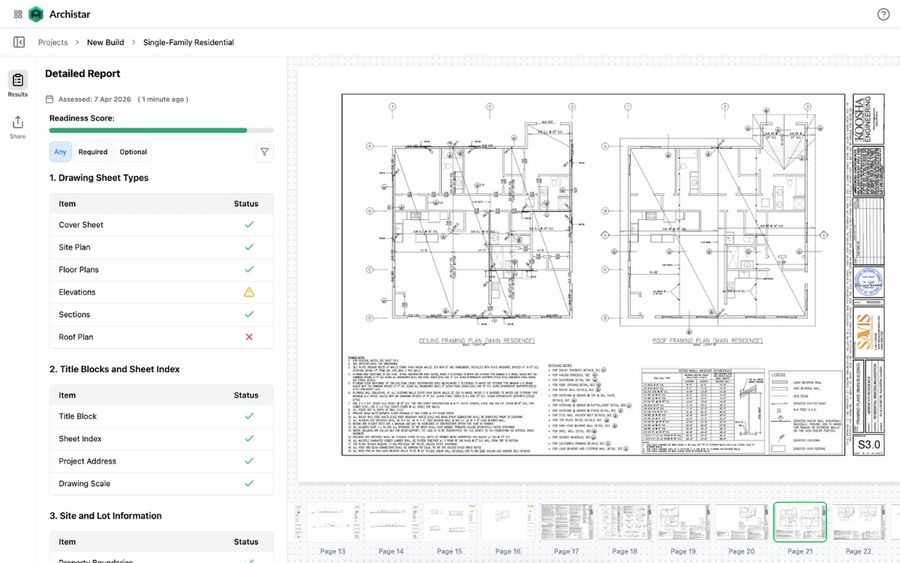
When Completeness Check finds what it’s looking for, it doesn’t just check a box. It extracts the information, tells you which page it’s on, and takes you straight there. A 200-page submission that used to take minutes just to open now surfaces its relevant details in seconds.
How It Works
Completeness Check works by verifying that required documents, plans, and metadata are present; cross-checking consistency across drawings and forms; and ensuring submissions match the intent of the application type, whether that’s a single-family remodel, a multifamily development, or a commercial build-out. It reads construction drawings the way a human reviewer would—recognizing a floor plan, section, or elevation—but does it across an entire submission at once.
It checks whether a required sheet exists and whether that sheet included specific details planners need. A floor plan without smoke alarm locations marked or a site plan without the yard setback labeled will get flagged even though the drawing itself is technically there.
But not everything Completeness Check looks for carries the same weight. Required elements feed into a readiness score from zero to 100. If the applicant misses enough of them, a submission won’t be eligible for review.
Meanwhile, optional elements, such as whether a project includes a basement or an accessory unit, are simply noted as present or absent so reviewers know what they’re working with.
Why Humans Shouldn’t Do This Alone
A trained reviewer can tell whether a submission is complete. What they can’t easily do is check every item, every time, at the pace cities now need to meet capacity. That’s the real case for AI here: not that it replaces judgment, but that it removes the busywork that used to eat up a reviewer’s day.
Think about that 200-page drawing set with no table of contents and no bookmarks. Before a plan reviewer can even start their real work, someone has to find where everything is. Completeness Check does that groundwork automatically, tagging and bookmarking the relevant pages so reviewers land exactly where they need to be instead of hunting for it. That’s cognitive burden lifted from every review, not because a person couldn’t do the work, but because it’s repetitive and mechanical and doesn’t need a trained planner’s time.
It also runs at a scale no reviewer could match, checking thousands of submissions in parallel and holding each one to the same standard. But Completeness Check isn’t making a compliance call. It’s not saying whether a setback is legal or a room is big enough. The tool is preparing the application, pointing to where the relevant information sits, and leaving the judgment to the person qualified to make it. It’s less a decision-maker and more a fast, consistent digital guide to the application. In other words, AI is not replacing the plan reviewer; it’s just helping them create capacity to get more done, faster.
From Emerging to System-Wide Trust
Once municipalities trust that every submission clearing Completeness Check is genuinely ready for review, the effects compound. Applicants get it right more often on the first attempt, which means fewer resubmissions and less of the back-and-forth that used to define permitting.
Review cycles get faster, too. Cities and counties using AI PreCheck have reported saving multiple business days per submission compared with their prior process, largely from cutting the time reviewers spend chasing missing information. For example, LA County saw a 54% average reduction in staff review time for like-for-like rebuilds after the 2025 wildfires.
For applicants, that means feedback that used to take days can now show up before they’ve even hit submit. For municipalities and councils, it means something just as valuable: predictability.
When every submission reaching a reviewer’s desk has already cleared a Completeness Check, a city knows its intake pipeline reflects real, assessable work rather than an unknown mix of ready and unready applications. Workloads stop being a guessing game because the information keeps arriving in a consistent, standardized way—no matter how differently each architect formats their drawings.
Preparing Cities for Scale
Two pressures are converging on municipalities right now. The first is housing supply: Improving affordability means getting more permits out the door, which means processing a growing volume of applications without a growing headcount to match.
The second is disaster recovery. As of mid-August 2026, firefighters in the US have responded to 46,636 wildfires that have burned more than 6.4 million acres. Meanwhile, this summer’s wildfires in Spain and France have burned nearly 300,000 acres (120,000 hectares).
A department built for business as usual can get overwhelmed suddenly if a surge of applicants who never expected to file a building permit application are forced to from a wildfire, flood, or other disaster. During and after a natural disaster, Completeness Check can become part of a municipality’s resilience infrastructure.
Both scenarios demand the same thing: a way to process far more submissions without asking already-stretched staff to do far more work. That’s only possible if intake can absorb volume without absorbing chaos, which is where standardizing readiness without standardizing design matters most.
Every architect has their own template and their own way of laying out a drawing set, and getting the whole industry to converge on one format isn’t realistic. But AI doesn’t need them to. It can take a submission in whatever format it arrives, extract the relevant information, and present it back in a consistent, structured way, regardless of how it showed up. Cities and counties get standardized readiness; applicants don’t have to change how they work; and when volume spikes, the system flexes instead of breaking.
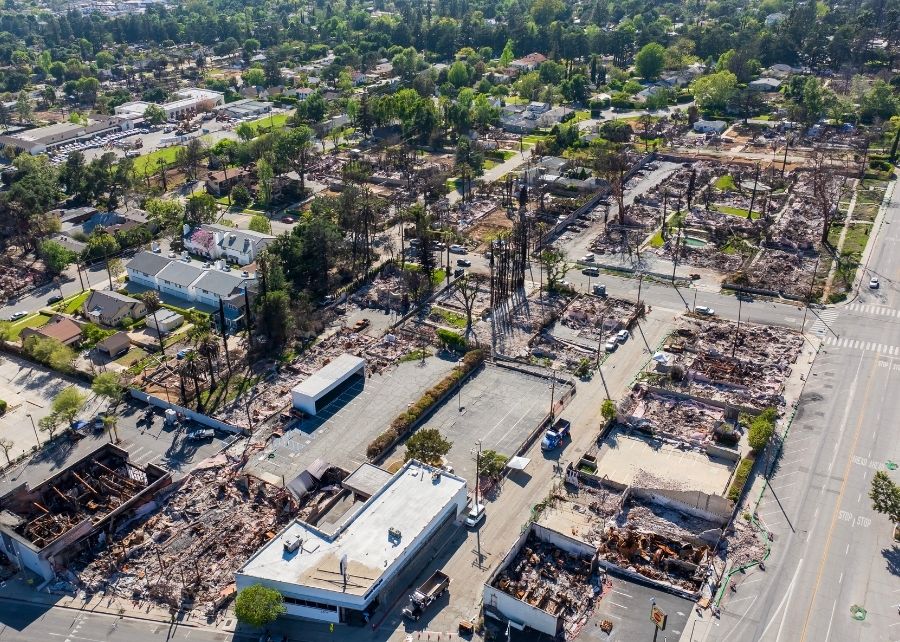
Homes and businesses on Lake Street in Altadena, CA, after the 2025 Los Angeles fires
A New Baseline for Digital Permitting
For most applicants, submitting to a city has always come with a quiet expectation of rejection: Send it in, get told what’s wrong, fix it, resubmit. That’s correction-driven permitting rather than readiness-driven permitting.
Completeness Check is part of a different approach—one that behaves like a customer-support specialist rather than a gatekeeper. Rather than waiting to catch what’s missing, it guides applicants toward a submission that’s ready to be approved in the first place. Even experienced architects benefit from this. Rules are written city by city, and it’s genuinely difficult to stay current on every jurisdiction’s specific interpretations, especially for firms working across multiple cities. Think of it less as a test and more as a sanity check—a spell-checker for architects that catches mistakes before it costs them a review cycle.
That shift, from rejection culture to readiness culture, is exactly why I think the fastest-growing municipalities of the next decade will start with completeness. The volume of permits isn’t slowing down, and the people needed to process them aren’t keeping pace with demand. Cutting resubmissions by even 30–50% frees up that same capacity in existing teams, without adding headcount and without asking planners to spend less time on the judgment calls that really need their time and attention.
The future of digital permitting isn’t simply faster compliance checking. It’s creating a reliable chain from submission readiness to automated compliance to informed human judgment.