

The same systemic housing problems of slow permitting, fragmented policy, and limited scalability affect both home affordability and disaster recovery.
AI-driven permitting and standardized housing design can increase speed and supply, reducing costs and enabling faster recovery and development.
Cities must evolve from regulators to platform designers, aligning policy, design, financing, and insurance to deliver housing at the scale demand requires.
Every year for more than two decades, influential real estate and land-use professionals have converged onto the Urban Land Institute (ULI) Arizona event. Developers, architects, planners, and others gathered at ULI Arizona Trends Day 2026 to examine the effect of federal policy on Arizona real estate, local market trends, the effect of energy sources and tourism on cities, and much more.
While the yearly event promotes making beneficial and strategic decisions within the real estate system, two panel conversations explored an important question: What if that system is broken?
These conversations explored different topics that turned out to be two sides of the same coin. The panel called “Rebuilding After Fires: Innovations in Recovery, Resiliency and Reform” brought together leaders to discuss which innovations could help rebuild with speed, equity, and resilience after the the January 2025 Palisades Fire and Easton Fire combined to cause nearly $80 billion in damage and destroyed more than 20,000 structures.
Meanwhile, “Adapting the American Dream: Rethinking Attainable Homeownership” examined whether innovative housing models, policy reforms, and financing tools could make starter homes more attainable for younger generations and diverse communities.
One panel was primarily concerned with affordability, while the other covered disaster recovery. Fundamentally, however, they were both about the ingrained problems with the housing system.
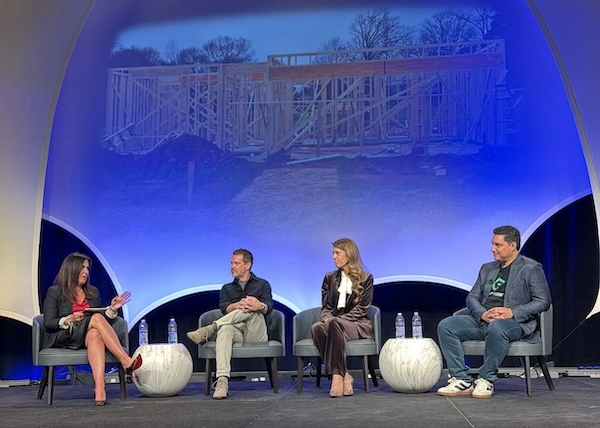
Rebuilding After Fires: Innovations in Recovery, Resiliency, and Reform panel from left to right: moderator Naijla Kayyem, Principal, Kayyem Marketing; Dustin Bramell, CEO, Pillar; Alison MacCracken, Real Estate Consultant, Certified Probate & Trust Specialist, Seniors Real Estate Specialist, Crest Real Estate, LLC; Dr. Benjamin Coorey, CEO, Archistar.ai. Credit: Makenna Francis
Housing Supply Can’t Keep Up
During “Adapting the American Dream,” the message was clear: The traditional path to homeownership is under pressure from rising costs and constrained supply. Ownership feels unattainable if not impossible for many younger prospective buyers.
“Entire generations assume they’ll never own a home,” says Walter Crutchfield, Partner and Co-Founder, Vintage Partners. “And if they don’t enter the ownership cycle, we lose them. That changes communities, schools, migration patterns—everything that homeownership supports.”
At the same time, “Rebuilding After Fires” painted a parallel picture. After entire Los Angeles neighborhoods were destroyed, thousands of families entered a rebuilding process that should have been urgent. But it wasn’t, because the system couldn’t move fast enough.
“Recovery doesn’t fail because people don’t care,” says Najla Kayyem, Principal, Kayyem Marketing, who moderated the panel. “It fails because the operational stack is broken.”
After working for the past year with many stakeholders through Steadfast LA, Kayyem says they learned some “universal truths”: Financing and insurance must align for recovery to succeed, but policy speed also matters. And to enable scalability, it’s important to utilize standardized design along with automated code checks.
Blocking these solutions are the old problems of permitting delays, regulatory complexity, and fragmented decision-making, all of which seem to rise to the top of people’s minds when the stakes are suddenly higher.
Disasters Reveal the Problems They Didn’t Create
Wildfires and other disasters that destroy homes don’t break the housing system; they just tend to expose what’s wrong with it. In an undisrupted housing market, approvals often take months instead of days or weeks, costs rise incrementally, and buyers are slowly priced out. It’s inefficient, but it’s inefficiency on a slow drip.
In the wake of a disaster, however, the inefficient timeline compresses. Suddenly, a locality needs thousands of new homes simultaneously, but a housing system built for one-off approvals doesn’t scale well, if at all.
When housing is needed urgently but the system can’t scale, its deficiencies surface. And whether it’s a matter of disaster recovery or affordable home ownership, the bottlenecks are basically the same:
- Slow, manual permitting process
- Fragmented zoning and regulations
- Custom, one-off house designs
- Misalignment between construction, financing, and insurance
“If even a professor of architecture struggles with the code system, the system itself needs help.”
Limits of a “One-Home-at-a-Time” Model
America’s current housing system too often operates under the assumption of designing and delivering one home at a time. This model breaks down when housing demand accelerates for any reason, be it rapid population growth of a region or rebuilding after a disaster.
As Dr. Benjamin Coorey, CEO of Archistar.ai, explained during “Rebuilding After Fires,” the permitting problem gets even worse after disasters because the system overloads. When Archistar partnered with the City and County of LA to validate designs against city codes using its AI PreCheck technology, he noticed some glaring examples of disfunction.
“One stood out to me,” he says. “An architecture professor submitted a design. Initially, it failed half of the required criteria. But after following the [AI PreCheck’s] feedback and revising the design, it passed everything. If even a professor of architecture struggles with the code system, the system itself needs help.”
Systemic permitting delays aren’t just inconvenient but can also be financially ruinous.
“Holding costs escalate quickly,” Dr. Coorey explains. “A single home may carry $10,000 per month in costs. A multifamily project can carry $500,000 per month. Reducing [permitting delays] by half can determine whether a project is financially viable.”
In everyday housing markets, slow approvals limit supply, which drives up prices, which pushes buyers out.
From Housing Projects to Housing Systems
Both of these ULI Arizona Trends Day panels pointed toward the need to shift from a housing project model to a housing scale model. At least for disaster recovery, that shift is gaining some momentum.
Instead of designing every home from scratch, leaders have pointed to a different approach, pre-approved housing catalogs. In offerings like the Foothill Catalog, architects design homes prioritizing resilience, affordability, and insurability. After initial approval, the designs can be reused, dramatically reducing future approval times.
To compound that advantage, digital tools like AI PreCheck are used to rapidly check designs against zoning rules, flag compliance issues instantly, and greatly reduce the back-and-forth between city staff.
Together, these approaches can result in a more predictable, scalable process that doesn’t only apply to disaster recovery. Themes from “Adapting the American Dream” included making everyday housing more affordable through higher-density development, smaller homes, and new product types that expand access. A more standardized, less bespoke system of housing productization could help address all of those needs.
Uncertainty Vs. Potential
Uncertainty plagues the housing system whether it concerns rebuilding or first-time home ownership. Mortgage expert Kelly Zitlow, Executive Vice President, Sales & Marketing Sr. Mortgage Advisor of Cornerstone Capital Bank, believes that people get the perception from social media that rates are too high and that buying a home no longer makes sense.
“Many still believe they need 20% down to buy a home,” she says. Her company educates prospective buyers that the historic low interest rates of 2020–2021 were not normal and that homeownership still has clear benefits.
“When we explain wealth creation through housing—appreciation, principal pay-down, long-term equity—people understand the math,” she says.
A parallel uncertainty shows up in disaster recovery, where people need confidence that rebuilding is possible. However, insurance coverage has become one of the biggest bottlenecks and sources of uncertainty in rebuilding.
Dustin Bramell, CEO of Pillar, noted during “Rebuilding After Fires” that he also lost his home in the 2025 LA County fires, and a huge issue is the gap between rebuilding costs and insurance payouts. “Many people are still paying mortgages on houses that no longer exist,” he says. “But disasters are not unpredictable. We can design for them, finance them, and insure against them if we plan properly.”
To do that, the housing system must align design and construction with policy and finance. Resilient design is no longer and option because housing projects stall without insurance.
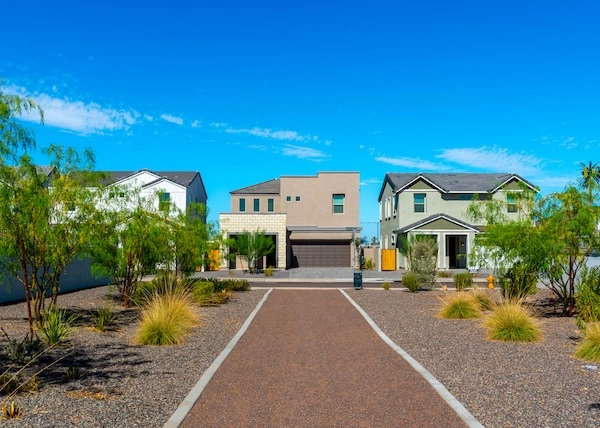
Housing demand remains strong in Phoenix, a top-five US growth market, according to the yearly outlook at ULI Arizona Trends Day 2026.
A New Opportunity for Cities
Fixing a systemic problem requires a systemic solution. The challenge and opportunity for cities is to evolve from being just regulators to being housing platform designers ushering in new possibilities for the home real estate market.
That means digitizing zoning rules and coordinating across stakeholders to streamline approvals. At the same time, standardizing housing options to include more pre-approved designs will help shift from saying “no” by default to orchestrating for “yes.”
On this sentiment, both sets of panelists were ultimately optimistic. Workable solutions like AI-driven permitting, pre-approved housing catalogs, resilient design, and new financing/insurance models already exist. They just need thorough adoption.
Housing affordability and disaster recovery are both affected by the same underlying problem: The current housing system doesn’t offer the speed and scale required today. Refining it will help cities rebuild after disasters, as well as assist future generations to achieve homeownership.
Cruthfield describes how Vintage Partners gets influential stakeholders onboard with building high-volume affordable housing by framing the conversation around the broader community benefit. They developed a project in Flagstaff, Arizona called Timber Sky that mixes starter homes of 400–500 square feet costing around $100,000 with standard single-family homes and higher-end homes.
“People assumed wealthy homeowners wouldn’t tolerate that diversity in a master-planned community, but they did,” he says. “People support solutions when they understand the purpose.”