


Lessons from building and planning conferences across North America have put forth a similar message recently: For building departments wanting to increase efficiency with AI tools, the results are only as good as the quality of data and processes going into them.
Municipalities that take the time to prepare or clean up their data sources before feeding them to AI reap the rewards. It’s not a question of whether AI tools for building permitting work. The City of Markham in Canada can tell you that they do, when they have the proper data.
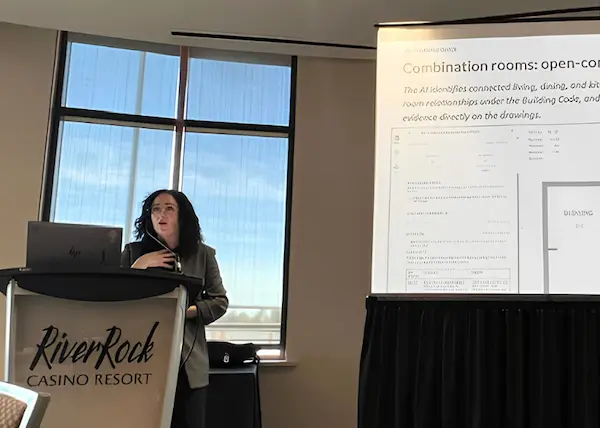
Stephanie Di Perna, Chief Building Official, City of Markham, presented “Responsible AI in Building Approvals: A Trust-Based Framework for Digital Permitting” at the BOABC 2026 Conference.
Markham’s AI Long Game Pays Off with Faster Plan Reviews
At the Building Officials Association of BC (BOABC) 2026 conference, Stephanie Di Perna, Chief Building Official, City of Markham, delivered a data-rich AI success story that featured the city’s digitization evolution. It begins in 2017, when Markham’s building department operated at what Di Perna calls “level zero,” fully manual, paper-based review.
”Up until 2017, this is how we reviewed building permit applications,“ she says. ”Multiple sets, lots of paper, fully manual. And this system was trusted because it was all we knew.”
Di Perna identified their paper-based problems as less about speed than about data. ”I’m a very data-driven person,” she says. “One of the key issues was we were unable to collect data properly in the paper world. Not just data for building permit reviews, but key data that the fire department would need. Does this building have a standpipe system? They should know that on the truck before going there.”
Her presentation was data-driven as well. She explained that Markham, a city of 360,000, handles approximately 3,500 building permits per year, with a construction value that has grown from around $1 billion to nearly $4 billion annually. At the same time, the building standards department grew from roughly 55 staff to 70. That’s a 400% increase in construction value, while staff only increased by 27%. The remainder of the capacity came from modernization.
This gradual journey to modernization started with zoning compliance and building compliance reports (the lowest-risk applications) and built upward incrementally. Electronic submission and plan review followed in 2017 and progressed onto in-field inspection apps, automated workflows, and then AI-assisted zoning pre-checks.
Each new layer of technology built upon the organization of paper-based data into digitized data. Along the way, each bit of technology also earned the staff’s trust, allowing them to feel good about moving to the next. Each level enabled a higher level by being completed, validated, and trusted.
Di Perna co-presented the session “Responsible AI in Building Approvals: A Trust-Based Framework for Digital Permitting” with Joe Philbrook, Vice President, Customer, Archistar. Markham’s current AI tools include Archistar’s AI PreCheck platform, including automated zoning compliance pre-checks and building code review capabilities. Philbrook spoke to the importance of a city’s staff establishing trust with high-tech tools.
“The problem often isn’t the technology,” Philbrook says. “The technology works. The challenge is trust.”
Markham’s incremental adoption and trust of AI tools has paid off while not surrendering any human control to the technology. For example, in 2009, Markham processed 32 permits per person per year. In 2025, that number more than doubled to 70. And complex building reviews were completed an average of 10 business days faster.
Still, Markham’s AI technology works as “a companion tool,” rather than a digital decision-maker. “We’re not rejecting or approving anything based on an AI output,” Di Perna says. “It’s still confirmed by a human. We’re starting with a pre-check more as a first pass.” Accountability remains with building officials, but AI reduces the volume of routine checks, so they can focus on more complex judgment calls.

The Jacksonville, Florida Riverfront Plaza, where the Hyatt Regency hosted the BOAF 2026 Annual Conference & Expo.
Standardize Data Sources for Permitting Accuracy
Markham built up to state-of-the-art AI tools gradually. For other jurisdictions starting from scratch, the likelihood that data is fully clean and ready to load into AI is fairly low, according to Derek Bush, Account Executive, Salesforce. He described the problem many cities have as structural in his presentation ”Cutting Through the AI: A Practical AI Roadmap for Building Officials” at the Building Officials Association of Florida (BOAF) 2026 Annual Conference & Expo in Jacksonville, Florida.
A typical building department has a permitting system, a zoning database, an archives platform, and a records management system. Each one stores information about the same properties, applicants, and contractors, but with different naming conventions, structures, and formats. The same applicant might appear three different ways, depending on who entered the record. The same address might be stored in a dozen variants. Across years of accumulated data, the inconsistencies compound.
“Fragmentation is the enemy of automation,” Bush says. “AI needs a single source of truth to be your assistant. It’s taking data from all of these different places and putting it into one place. If your data is a mess, AI will confidently give you the wrong answer.”
Bush described two ways AI may give you the wrong answer. The first, hallucination, happens when AI generates information not grounded in any data. For this, Bush recommended that cities constrain the AI by using only their own data, with guardrails that prevent the AI model from drawing on public internet sources that have nothing to do with their jurisdiction. “The idea is using AI with your own agency data,” he says. “It minimizes the opportunity for hallucination, because it only knows what you’ve taught it.”
Data fragmentation is the the second catalyst for AI confidently returning the wrong answer. The underlying data may have 15 versions of the same entity and no way to distinguish which one to trust. This type of AI failure is the more common one. It some ways, it’s more dangerous too, because the output looks authoritative.
For this, Bush prescribes harmonizing a city’s data by creating a unified coordination layer across all systems. His following live demo of Salesforce Agentforce showed examples of what could be done with AI only after preparing an organization’s data.
Improve Processes to Get the Most from AI Permitting Software
While data quality is key to implementing AI, process clarity is important too. Chris Blough, Management Consulting Principal, Plante & Moran, advocated for documenting your processes at BOAF 2026 in the “Adapt or Stagnate: Permitting Workflows Built for Tomorrow“ session.
It presented a five-step framework for gaining back permitting capacity through workflow improvement:
- Step 1: Document What Really Happens—Map and analyze the process.
- Step 2: Define What Success Looks Like—Set clear goals and metrics.
- Step 3: Staff or Backfill Improvements—Plan capacity for change.
- Step 4: Prioritize Quick Wins—Tackle high-impact tasks.
- Step 5: Standardize Where It Matters—Create consistent procedures.
“The first two steps are the ones everyone skips,” Blough says. “Those two take some work. And we often find people want to jump right to the technology and get the staff involved. Well, we can’t get to steps three, four, and five unless we’ve done our homework.”
Plante & Moran’s point, derived from client engagements, is that most permitting workflows contain significant complexity not visible to leadership. For example, there may be 20 extra steps happening inside an external review discipline that nobody knew about, Excel sheets that proliferated when a system couldn’t accommodate a new ordinance, or handoffs that delay information every time they move between people.
Until you’ve mapped the reality of the current workflow, “the role that does the work, the system it’s done in, and where the handoff occurs,” you don’t actually know what you’re trying to improve.
Skipping this step risks amplifying the problems. AI for building permits can improve capacity, but if applied to a broken workflow, it can stagnate. “Technology can amplify your process, good or bad,” Blough says. “We’re not letting the technology dictate the process. Our process will dictate how the technology aligns.”

The Thames River in London, Ontario, where the RBC Place hosted the MISA Ontario 2026 Annual Conference and Tradeshow.
The AI Cities Already Use (But Don’t Know About)
Besides data organization, there’s another crucial dimension to government data and AI: keeping it out of the wrong places. At MISA Ontario 2026, Cole Cioran, Managing Partner, Canadian Public Sector, Info-Tech, spoke to risk management for the various unaccounted AI tools already being used by local government staff.
In his presentation, “Digital Sovereignty, AI, and Changing Expectations,” Cioran asks the audience, “Any of that shadow AI going on?” The affirmative response showed that yes, AI tools are already embedded in municipal workflows. Whether they come through commercial software platforms, unsanctioned employee-adopted productivity tools, or AI features bundled into existing SaaS contracts, a large amount of AI in local government gets through without formal policy, governance, or even awareness at the leadership level.
While feeding AI fragmented data can cause workflow problems, this use of “shadow AI” triggers whole other layers of risk concerns. These AI tools are already ingesting operational data, the staff’s institutional knowledge, and decision patterns. Potentially they can be training AI models that a vendor controls and the municipality doesn’t. The tacit knowledge that a city’s most experienced staff carries, the kind that Cioran says shows up as workarounds on office sticky notes, is exactly what AI tools are best at capturing.
“It’s time to stop talking about AI and start doing AI,” Cioran says, “but doing it in a very specific context.” That context means building an inventory of the AI already in your environment, integrating AI risk into your enterprise risk management framework (rather than treating it as a separate IT problem), and making sure that nothing captures your institutional knowledge other than your own systems.
Building the Foundation Leads to AI Permitting Success
The lessons from these sessions converge onto a sequence for success with AI permit backlog software. Understand your process, clean your data, govern what you already have, and then deploy AI to amplify what’s working.
Markham got to 70 permits per person per year because it spent the time building a foundation that complemented Archistar’s AI permitting software. Other municipalities can observe Markham’s practices and repeat them in a compressed timeframe. Those that will benefit the most from AI in the coming years will be the ones that prepare their data and processes first.