
- AI is shifting from general productivity tools to city-specific applications that improve municipal operations, planning, safety, and services.
- Key use cases range from asset management, digital permitting, and urban planning to public safety and citizen engagement.
- Used well, AI can help cities become more efficient, resilient, and livable by 2026 while reducing costs and strain on public staff.
AI in commercial real estate (CRE) is here now, and it’s here to stay. AI real estate tools are reshaping the industry and the planning, approval, construction, operation, appraisal, and marketing of commercial buildings.
Some property developers, asset managers, architects, and other commercial real estate professionals may be concerned that AI will replace them. However, it’s more likely that competitors using AI will replace them if they don’t adopt AI technology accordingly.
With AI-driven tools, designers can more efficiently create higher quality and more adaptable models. As a result, property developers and construction crews benefit from fewer delays and more accurate models. AI technology in commercial real estate can take control of a lot of manual work, helping to relieve regulatory bottlenecks and affordability pressures by reducing the time and risk for producing efficient, adaptable spaces.
On the other hand, mere adoption of AI does not guarantee success. Worldwide, commercial real estate firms and investors are betting huge amounts on AI tools, yet they may struggle to deploy them for measurable value.
That’s why in this article, we explore nine AI technologies reshaping how commercial real estate is analyzed, developed, and managed today. Adopting AI is no longer optional. Real estate and architecture firms, city planners, and universities preparing their students must face the reality of the rise of AI in commercial real estate—but do so with a clear-eyed view of what really works.
1. City Operations and Asset Management
Examples: Fracta; vialytics; Vivacity Labs; NoTraffic; Enevo; Telensa;
The same type of real-time data analysis used for disaster and crime alerts can also apply to using AI for the everyday optimization of city operations.
For example, vialytics uses camera data to detect or predict potholes, cracking, and other damage to roads, as well as to other assets like drains and street signs. A similar methodology allows Fracta to use machine learning from incoming data to predict failures and damage to water mains and pipes, as well as predicting the cost of such failures.
Traffic congestion can also plague a city’s livability. Smart city mobility AI tools like those from Vivacity Labs and NoTraffic can help. They use computer vision sensors to autonomously manage traffic signal timing to relieve congestion.
Another class of AI tools uses IoT sensors to detect the fill levels of waste bins and optimize waste collection schedules. Check out Enevo’s waste analytics technology.
Smart street lighting AI can also make the best use of city energy resources. With adaptive AI like Telensa or Signify Interact, sensor feedback and big data analytics can optimize lighting schedules for different zones like industrial, residential, and highways. They can also detect lamp failures and predict outages before they become a problem.
Benefits of AI for city management include:
- Reduced operational costs.
- Extended asset life and failure prevention through predictive maintenance.
- Improved service delivery and response times.
Common applications:
- Predictive maintenance for roads, water networks, and public buildings.
- AI-powered traffic and congestion management.
- Waste-collection routing based on real-time fill levels.
- Smart street lighting and energy optimization.

2. Citizen Services and Digital Engagement
Examples: TechForGov IGNA; 3Di Virtual City Hall
AI technology can enhance civic engagement for local governments wanting to improve how residents interact with their city. Multi-purpose apps and tools can offer 24/7 citizen answers with AI chat bots and voice bots, along with intelligent alerts, forms, and other insights.
Two great options include TechForGov IGNA and 3Di Virtual City Hall. Both are AI-powered products that include mobile apps with conversational front ends.
Local governments can use IGNA for citizen engagement campaigns, while citizens can get answers, applications, and status reports related to things like property permits.
Virtual City Hall bills itself as a one-stop online City Hall for public comments, service requests, planning/permitting, and two-way engagement around council meetings, ordinances, and the like.
Benefits of AI for local government include:
- Faster, more personalized services.
- 24/7 access to planning, permits, and city information.
- Improved public satisfaction and transparency.
Common applications:
- AI assistants for planning enquiries, submissions, and code interpretation.
- Multilingual support chatbots for community services.
- Automated responses for common council requests (potholes, waste, permits).

Vancouver City Hall in Vancouver, BC, Canada.
3. Urban Planning and Scenario Modeling
Examples: Archistar 3D Generative Design Forma Add-on; ClimateAi; UrbanSim; Kinetica
AI for urban planning and scenarios can take several forms, such as modeling future city growth, infrastructure demands, and environmental impacts.
Generative design and machine learning can apply when planning or redeveloping precincts, evaluating a site’s feasibility, rezoning, and more. Archistar’s technology, such as the Archistar 3D Generative Design Add-on for Autodesk Forma, is useful for rapid feasibility assessments and site capacity modeling. It responds instantly to different site constraints, generating many design options for variables including heights, setbacks, and environmental and zoning requirements.
UrbanSim forecasts infrastructure needs using citywide simulations. It aims to reduce the resources needed for smart sustainable development.
Other smart planning tools can identify urban heat islands using geospatial and IoT sensor data. ClimateAi provides hyper-local insights and can test heat-mitigation solutions like cool roofs and tree canopies. And Kinetica takes in massive city-wide datasets to calculate things like carbon budgeting, climate action, and neighborhood air-quality improvement.
Benefits of these technologies include:
- Evidence-based decision-making for land use and infrastructure.
- Ability to test policy changes or zoning reforms before implementation.
- More accurate forecasting of housing supply and development capacity.
Common applications:
- Generative scenario modeling for planning precincts
- Infrastructure demand forecasting (schools, transport, utilities).
- Heat island and emissions modeling for climate resilience.
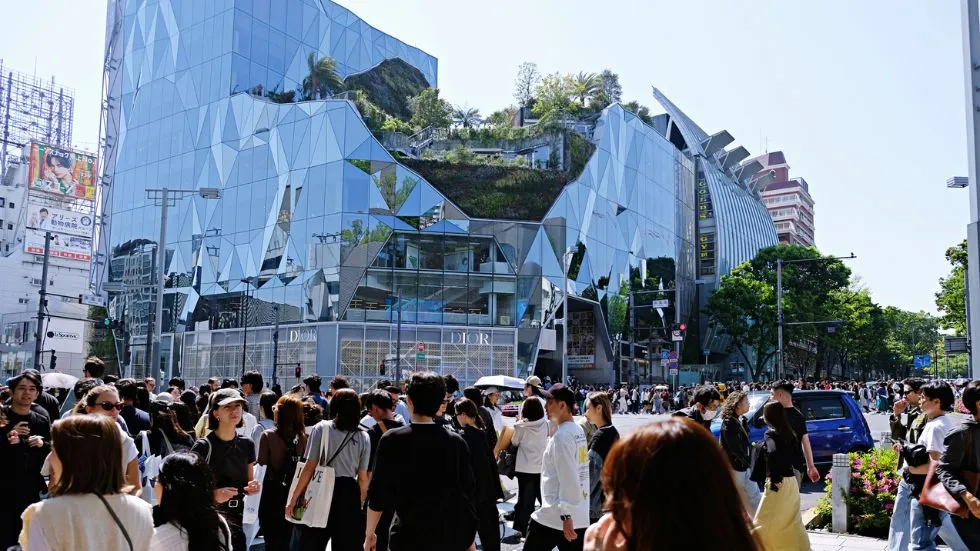
The green rooftop gardens on the 5th, 6th, and 7th floors of the Tokyu Plaza Harajuku Harakado building help mitigate the urban heat island effect in Tokyo, Japan.
4. Public Safety and Emergency Management
Examples: Willow digital twin, Autodesk Tandem, Bentley iTwin
Digital twins’ surging adoption in commercial real estate coincided with their integration of AI-enhanced full lifecycle management. These AI-accelerated digital twins improve building designs before construction. They are powerful tools for maximizing operational efficiency, managing lifecycle costs, and meeting ESG requirements.
AI-optimized digital twins can simulate:
- A building’s energy performance under various conditions
- Future maintenance needs
- Operational costs
- Carbon impacts for ESG reporting
- Occupancy flows and congestion
- Renovation and retrofit outcomes
5. Digital Permitting and Automated Compliance (Planning and Building)
Example: Archistar AI PreCheck (formerly eCheck)
Local zoning laws and building codes are often lengthy, highly detailed, and subject to regular updates. Their specificity has made it difficult for real estate developers to achieve compliance. As a result, building permit approvals often take much longer than anyone wants: many months or too often, years.
Dedicated AI technology like Archistar AI PreCheck can take away much of the pain, delays, and associated holding costs from building permitting. It can instantly scan digital project plans for compliance to local ordinances. It checks for setbacks, height limits, overshadowing, private open space, lot coverage, floor space and area ratios (FSR/FAR), and much more.
With AI PreCheck, architects and developers receive detailed reports that flag any violations in their designs, so they can address them before submission. This saves significant time by cutting down resubmission cycles.
City councils or state agencies using AI PreCheck can rapidly handle pre-lodgement assessments, instantly evaluate submitted designs, and use the tool for streamlining rezoning studies and compliance submissions.
Benefits of these technologies include:
- Cutting permit turnaround to a fraction of the time.
- Reducing administrative burden on assessors.
- Improving consistency and transparency of decisions.
- Enabling applicants to accurately self-assess before submitting.
Common applications:
- Automated zoning compliance, including setbacks, height, FSR/FAR, and land-use permissions.
- Automated building code checks, such as egress, accessibility, and fire safety.
- Digital permitting workflows integrated with city council systems.
It’s Time for an Urban Renewal
City employees, council members, managers, and mayors are often stretched to their limit with demands for improvements. A whole array of innovative AI-powered technology offers city administrators dedicated functionality to address some of the most pressing municipal needs.
The powerful data-processing abilities of smart cities AI can optimize a city’s flow of traffic, water, and waste disposal while speeding up formerly lengthy processes like building permit compliance checks. If used wisely, AI could help make cities better places to be in 2026.