


- Change management for AI is the biggest barrier to success in government because cities must align culture, workflows, data readiness, and staff trust before AI can scale.
- Human-AI collaboration is essential for high-impact use cases like permitting and housing, but it can’t be done well without continuous training of AI models and public servants.
- Taking a pilot into production requires structured, repeatable framework, including defined goals, iterative testing, cross-department alignment, and ongoing performance tracking.
While AI holds the promise of saving an incredible amount of time and money for municipalities around the world, it’s not like mayors, city managers, and city CIOs can wave magic wands and manifest instantly well-oiled, AI-infused machines.
Yes, AI can sift through terabytes of data in seconds, but the biggest challenge of integrating AI into cities is not technological—it’s organizational. Planning and regulatory departments are often understaffed, and new AI tools require training and new processes to onboard into existing systems. And to work well, AI solutions need to be highly tailored to meet the needs of the city departments.
At the GovAI Coalition Summit in San Jose, CA in November 2025, public servants from local, county, and state governments around the US gathered to discuss what ethical and responsible AI governance and adoption should look like.
During a panel called “Beyond the Pilot: Scaling AI Integration for Maximum Impact,” Dr. Christopher Rodriguez, Assistant City Administrator for the Government of the District of Columbia in Washington, DC, was candid that AI vendors should be careful to avoid overselling their solutions.
“I’ve sat in meetings where people tell me all the time—at least once a week—that they can solve all my problems,” he says. “And, you know, their solution is the solution. What I also see is that they also don’t understand how we do business. And some don’t take the time to really understand the functions that our government does.”
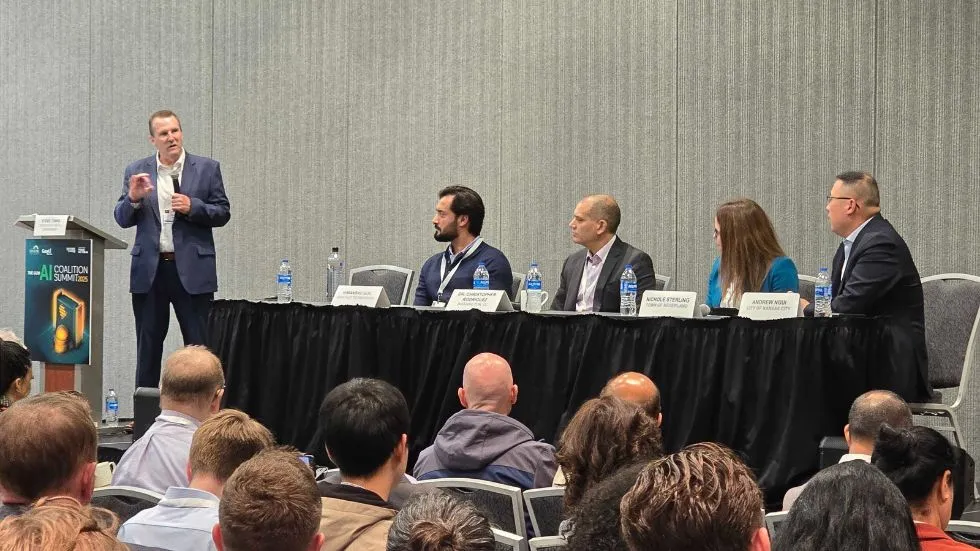
“Beyond the Pilot: Scaling AI Integration for Maximum Impact" panel. From left to right: Steve Towns, Himanshu Goil, Dr. Christopher Rodriguez, Nichole Sterling, and Andrew Ngui. Photo credit: Bayon Shahidi.
Human-AI Collaboration for Housing Supply
Even with successful implementation, AI tool adoption can stall if the municipal staff fears that automation might eventually replace their jobs. Even with all the evidence illustrating that AI augments humans and increases their capacity by taking over mundane, repetitive work to free up time for more complex tasks, adoption can be slow.
But with housing crises mounting around the world, human-AI collaboration is a crucial solution to meet demand. City of San Jose, CA Mayor Matt Mahan noted during the GovAI summit that one of the biggest AI opportunities for government is to streamline building permit approvals.
“You think about permitting: You’ve got objective standards and building code and zoning and land use designations,” Mahan said during the “Leading with AI: How Public Leaders Are Shaping the Future of Government” panel. “An application has structured data that shouldn’t take a year to match up and figure out, ‘Do the parameters in the application match the objective standards?’ We actually could probably spit that into a machine and tell you pretty quickly,” he said. “So I think there’s a lot of runway here for making government services better.”
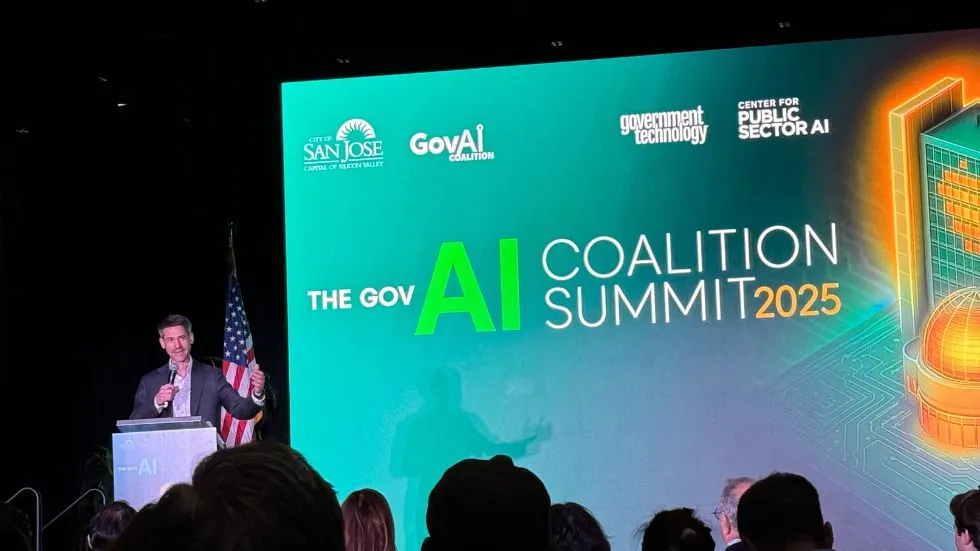
City of San Jose Mayor Matt Mahan speaking at the GovAI Coalition Summit in San Jose, CA. Photo credit: Bayon Shahidi.
The Phased Pilot Strategy
Some AI technology for permitting has already been proven out and has stood the test of time. For example, Archistar AI PreCheck (formerly eCheck) is already speeding up the permitting process in over 30 cities across the US, Canada, and Australia.
Many cities that need reliable human-AI collaboration right away go straight into production. For those that instead need to ease into the process, a pilot can be a safe bet. However, a pilot requires a framework—not jumping in too quickly without a solid plan. This was a hot topic during the panel “A Good Pilot Knows How to Quit” at the GovAI Coalition Summit.
“We’ve learned this the hard way,” said PJ Rodriguez, Chief Operating Officer for the IT department at the City of Bellevue, WA. “You can’t just jump in because you’re excited [and say,] ‘Let’s just feed everything into this AI, and then let’s see what comes out.’ Nothing good comes out of that strategy.”
Rodriguez said he and his team ensured a higher rate of success through data readiness and by following a phased approach. “For each of the phases that we have for our projects, we have defined success criteria, and we have gates for each of those phases. At the end of each gate that we have, [we ask ourselves,] do we move on to the next? Do we not move on? Do we pause? Do we stop?”
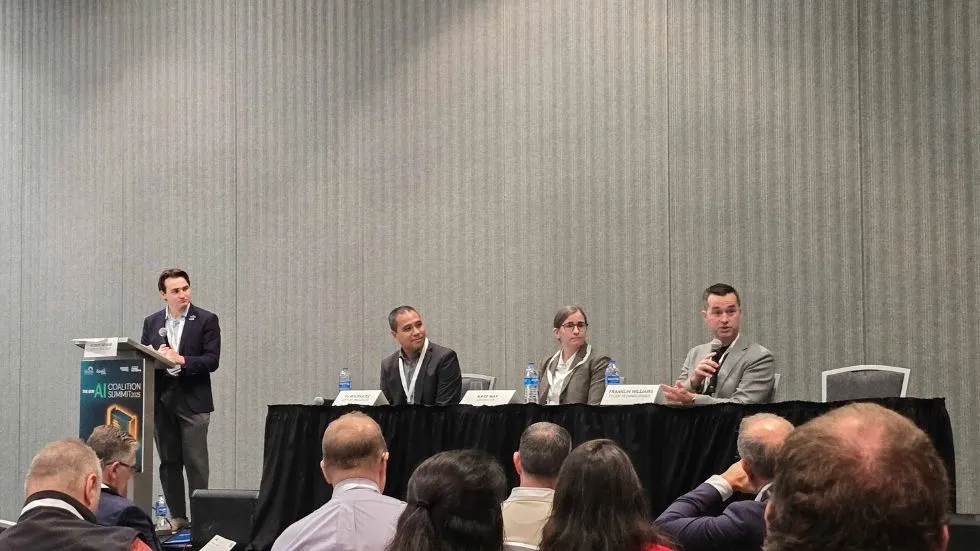
“A Good Pilot Knows When to Quit" panel. From left to right: Albert Gehami, PJ Rodriguez, Kate May, and Franklin Williams. Photo credit: Bayon Shahidi.
The Training Approach
To get an AI pilot off the ground, there’s a matter of training city employees as well as the AI itself—because both humans and AI make mistakes.
During the “Good Pilot” panel, Privacy and AI Officer for the City of San José, Albert Gehami, discussed the human-AI collaboration necessary to mitigate AI errors.
“We need to be able to correct it when it’s incorrect or produces the wrong results,” he said. “It’s about testing the AI to make sure that it’s getting you 80% of the way, and then how do you have that quality control for that last 20%? I think about that a lot in some of the pilots that we do in San Jose. [Maybe the AI is] spending all the time looking at the street trying to detect if there’s a pothole, but there’s illegal dumping in the way.”
Kate May, Principal of Product Management at Granicus, said her team uses other AI tools to judge whether the AI in training is doing its job correctly. Granicus’s Government Experience Agent (GXA), an AI-powered digital agent for the public sector, was trained to anticipate the most common 700 to 1,000 questions coming from the community.
“We go through a multistage iterative testing process that we actually leverage other AI to judge AI,” she said. “But we always make sure that we have humans doing the final judgment.”
GXA’s AI must manage varying levels of complexity from questions coming in from the community, from inquiries about City Hall’s hours to complicated questions about construction projects. “For this product, we don’t train it—we tune it,” she said. “We curate the content that it’s accessing. And what we find in this testing process is often the answers aren’t in the content that it’s ingesting from the agency because the agency has never thought to put certain bits of nuance in that content.”

The Path from Pilot to Production
When a municipality deems a pilot successful, the next step is to create a plan to scale it across the government agency. During “Beyond the Pilot,” panelists discussed a five-point process to scale an AI project from pilot to production.
- Define the purpose of the AI project
- Set goals and run a pilot
- Define the framework and create a step-by-step playbook
- Take the AI technology into production and scale
- Track performance and keep training/fine-tuning AI models
On top of developing a strategy and plan, change management is also key.
“A different mindset is required,” said Himanshu Goil, Chief Executive Officer at Ignatiuz/TechforGov. “This is not a technology change where you bring a new laptop, and everybody will be using the laptop now. We are getting into this AI development journey, and it requires a culture shift.”
Part of that is ensuring that all departments within a government agency are aligned in their processes and tech stack.
“It’s like you’re building the thing and then [you have] the shiny, awesome thing that everybody gets to brag about,” said Andrew Ngui, Chief Digital Officer at the City of Kansas City, MO. “And then after that you realize, ‘Oh, all our processes, they don’t actually fit.’ You know, one department could be using paper and other departments PDF and other departments Excel spreadsheets.”
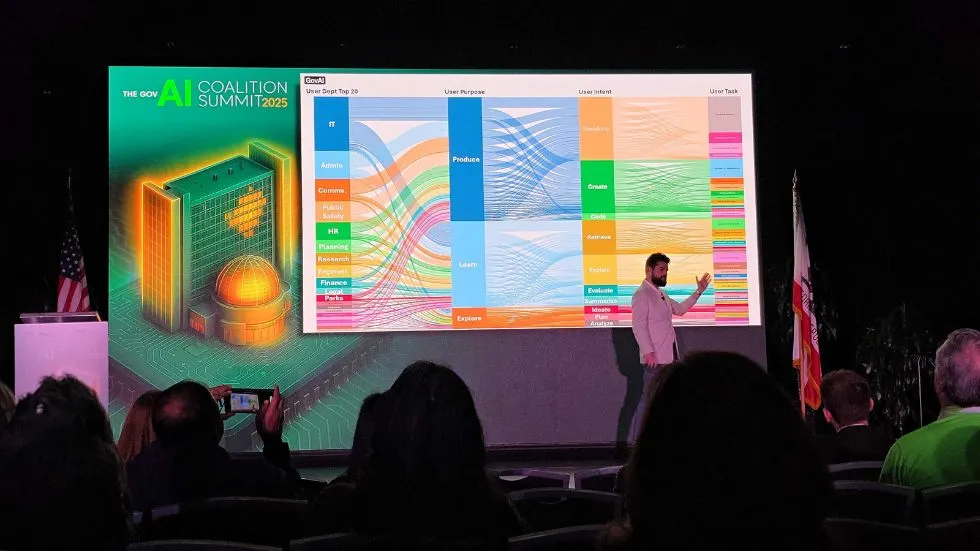
AI Opportunities with the Most Impact
Example: Archistar AI PreCheck
Local zoning laws and building codes are often lengthy, highly detailed, and subject to regular updates. Their specificity has made it difficult for real estate developers to achieve compliance. As a result, building permit approvals often take much longer than anyone wants: many months or too often, years.
Dedicated AI technology like Archistar AI PreCheck can take away much of the pain, delays, and associated holding costs from building permitting. It can instantly scan digital project plans for compliance to local ordinances. It checks for setbacks, height limits, overshadowing, private open space, lot coverage, floor space and area ratios (FSR/FAR), and much more.
With AI PreCheck, architects and developers receive detailed reports that flag any violations in their designs, so they can address them before submission. This saves significant time by cutting down resubmission cycles.
City councils or state agencies using AI PreCheck can rapidly handle pre-lodgement assessments, instantly evaluate submitted designs, and use the tool for streamlining rezoning studies and compliance submissions.
Benefits of these technologies include:
- Cutting permit turnaround to a fraction of the time.
- Reducing administrative burden on assessors.
- Improving consistency and transparency of decisions.
- Enabling applicants to accurately self-assess before submitting.
Common applications:
- Automated zoning compliance, including setbacks, height, FSR/FAR, and land-use permissions.
- Automated building code checks, such as egress, accessibility, and fire safety.
- Digital permitting workflows integrated with city council systems.
It’s Time for an Urban Renewal
Ultimately, the big question a municipality needs to ask itself before taking AI into production is whether it’s going to create enough impact to warrant the effort. Nichole Sterling, Mayor Pro Tem for the Town of Nederland, CO and Founder and CEO of My Town AI, learned from an advisor to her company, her father, to look at the big picture.
“In the end, if all you end up doing is more busy work or administrative work, are you really moving the needle with AI? One of the things that I look at is, what would I say yes to as an elected official? I would say yes to more quantifiable dollars coming into my community and getting to break ground faster for development, right?”
Sterling is currently working on AI pilots focused on affordable housing and childcare facilities. “Right now, $2.7 trillion is the affordability housing gap,” she said. “Childcare infrastructure, the lack of it, is another $1.2 trillion. Restricted land use is costing us $1.95 trillion each year. All those things accumulated, those are the types of outcomes that I’m trying to reduce the opportunity friction for our communities so that they can get more of those dollars flowing into their communities faster.”