
The numbers around housing affordability in North America don’t lie. For example, from 2019–2024, the price of housing in the United States increased 31%, while household income climbed only 22%. In Canada, the gap is even more severe: Home prices surged 53% compared to income increases of just 13% from 2015–2025.
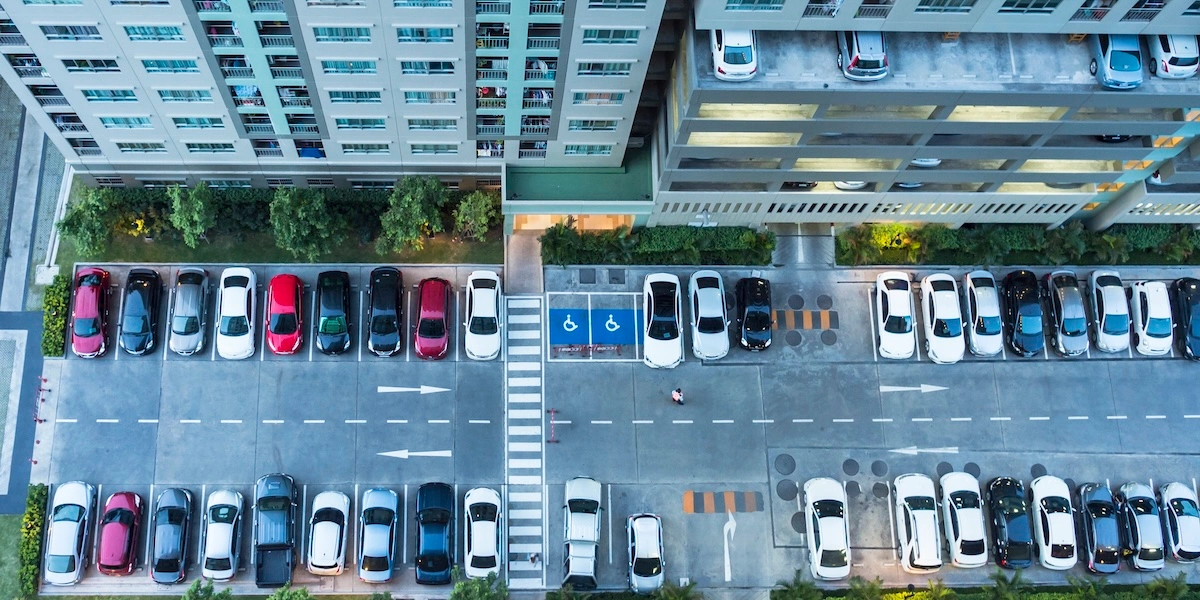
While the trend on affordable housing is clear, what to do about is less so. However, at the PIBC 2026 Annual Conference, three presentations independently pointed to a somewhat counterintuitive insight: Parking policy has a direct impact on housing costs. Fixing parking policy, specifically parking minimums, promotes hosing affordability.
The City of Kelowna in British Columbia, Canada, reviewed two years of parking complaints related to new development, and the vast majority came from areas with no on-street parking time restrictions, paid parking, or other controls.
“The key point here was that 98% of complaints for parking-related issues with new development were in areas where there was no on-street parking control,” says Adam Cseke, City of Kelowna Development Planning Manager.
Cseke led the city’s parking reform process and presented the findings at the PIBC 2026 session, “Parking Reform—Increasing Mobility Choices Through New Development.” He says that the surrounding streets “contained unmanaged street parking, which exasperated the problem because neighbors became accustomed to free and unlimited parking on the street.”
The distinction between a parking shortage and a parking entitlement could unlock a much larger conversation about housing affordability. If the complaints driving parking minimums aren’t really about insufficient supply, then the minimums themselves are answering the wrong question. And those minimums carry a cost that shows up directly in housing prices.
The Hidden Tax Inside Every Housing Unit
Another PIBC 2026 session, “Housing Needs, Demographics Change and the Role of Planners,” opened with a challenge that applies directly to parking: the tendency to confuse housing wants with housing needs.
The presenter Kevin Green, Associate Director, CitySpaces Consulting, quoted a recent Planning West article by Asim Nadvi, Deputy Director of Planning at the City of Maple Ridge. It says, “Traditional public engagements are often mired in the wants of current residents and overlook potential future residents or underrepresented segments of society.”
The same dynamic plays out with parking. People objecting to a new development’s parking ratio are overwhelmingly current residents whose own housing needs are already met, who drive, and who have organized their daily life around unlimited free street parking. Their preferences get encoded into minimum parking requirements. Those requirements then apply to every new development, in every context, regardless of how transit-accessible the site actually is.
Green presented research by economist Nathan Zemp that quantifies the financial consequences as the “zoning effect.” It’s the portion of a home’s sale price attributable to land-use restrictions, including density and parking rules. Zemp estimated this portion of housing prices in cities across British Columbia:
- Delta: 71% of the average $950,000 sale price
- Victoria: 70% of the average $820,000 sale price
- Metro Vancouver: 59% of the average $1,000,000 sale price
- Kelowna: 44% of the average $420,000 sale price
- Fort St. John: 15% of the average $59,000 sale price
This shows that where restrictive zoning constrains land use, the majority of a home’s price is regulatory overhead. Rather than construction costs or natural land value, rules that limit what can be built and where create price premiums. Parking minimums are part of those premiums.
The Grand Bargain Nobody Agreed To
Green’s session continued by introducing the concept of the “Grand Bargain of Tall + Sprawl.” It argues that British Columbia’s housing market has been structured around two extremes: high-rise urban residential towers and the suburban sprawl of detached houses. High-rise towers are expensive because of construction cost, whereas detached houses are expensive because of land cost. For structural reasons, both ends of the spectrum are the least affordable forms of housing.
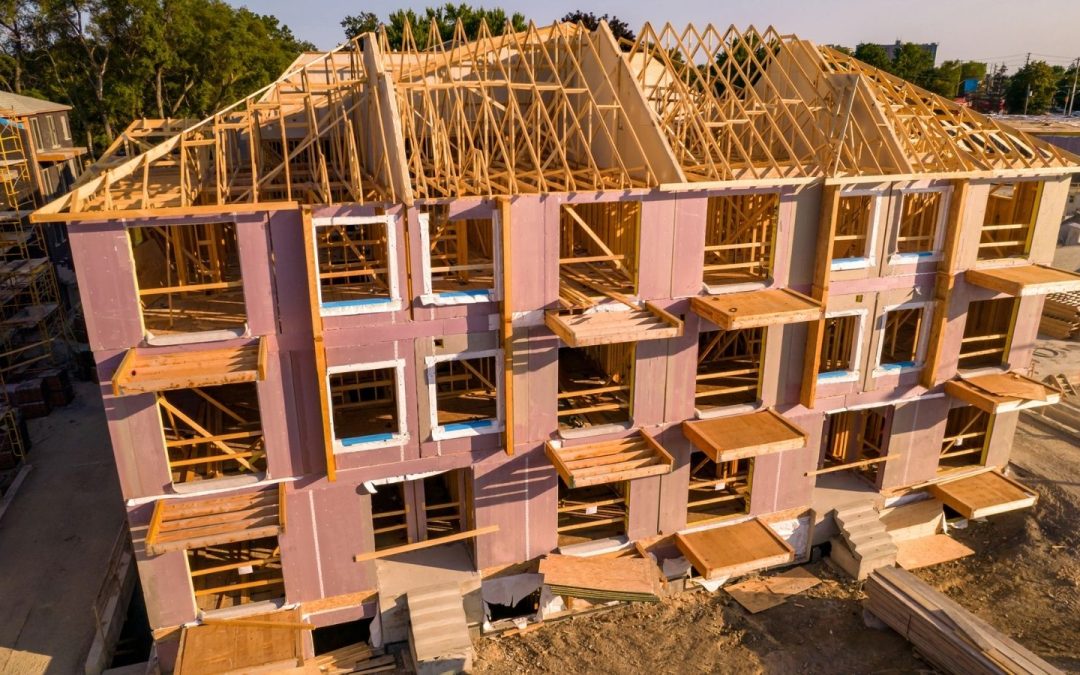
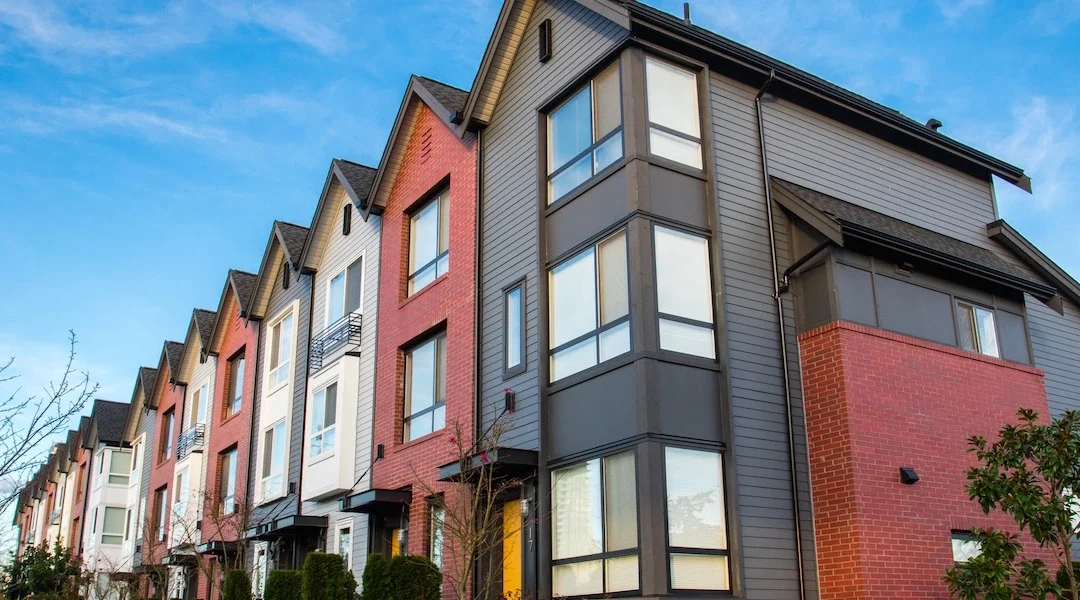
Meanwhile, the “missing middle” housing units, like multiplexes, rowhouses, and low-rise wood-frame apartments, actually offer the best shot at affordability.
However, minimum parking requirements are one of the big reasons why not enough missing middle housing gets built. A rowhouse or four-plex on an urban infill lot can rarely accommodate a full parking stall per unit without either underground structured parking (which typically costs $50,000–$80,000 per stall) or a surface lot that consumes land that would otherwise hold housing units. As a result of the economics, the most affordable form of housing gets squeezed out by a policy designed to manage complaints that Kelowna’s data shows are not actually about parking supply.
“While everyone might want to live in a detached house, I wonder if they really need to,” Green says. “The country needs to reckon with this cultural preference of owning a house. I don’t think it’s about convincing people to have less than they expected. It’s just giving them the option to choose a positive alternative to what they imagined. For that to viable, those homes have to actually exist.”
How Kelowna Made the Politics Work
The City of Kelowna solved two problems that typically defeat parking reform efforts: the technical challenge of calibrating the right parking minimums and the political challenge of getting councils to approve a reduction.
On the technical side, the city used ICBC vehicle registration data to base its parking minimum standards on vehicle ownership, rather than assumptions. The ownership averages—1.7 vehicles per household in Kelowna’s central areas versus 3.7 vehicles per household in suburbs like Glenmore and Black Mountain—show that a single citywide parking minimum never accurately reflected either number.
“We needed to better connect off-street parking regulations with the actual demand for parking per household,” Cseke says. “The data from ICBC gave us that.”
On the political side, Kelowna and its mobility consultant, Dale Bracewell, Principal, Mobility Foresight, made the deliberate strategic choice to frame the entire reform as net-neutral. Parking minimum standards would increase in suburban areas where they were below actual ownership rates and decrease near transit, where they exceeded real demand. The overall change was balanced.
The final package included three incentives developers could use to qualify for additional parking reductions: purpose-built rental housing, additional bicycle parking beyond the minimum, and transportation demand-management tools, including transit pass subsidies and car-share memberships bundled into the development. The maximum combined parking reduction was capped at 45%. They replaced the previous cash-in-lieu system, which allowed developers to simply buy their way out of parking requirements without changing travel behavior.
Bracewell explained transportation demand management (TDM) as designing based on the geography that affects how many people need to drive versus how many could take transit, bike, or walk. When done well, it can change not only parking supply, but also parking demand. “Transportation demand management is simply the provision of the tools that can actually reduce the amount of parking and still meet multiple city objectives,” he says.

The Parking/Infrastructure Connection
Kelowna’s reform of parking minimums as a lever for affordable housing won’t be the last word on parking reform. There are other concerns that parking minimums can affect, such as infrastructure capacity.
In their PIBC 2026 session, “Countdown to Detonation: Bill 44 and the Infrastructure Time Bomb,” Chris Osborne, Manager, Planning and Clay Reitsma, Director of Engineering, both of the Municipality of North Cowichan, presented evidence that density mandates create servicing demands that existing water and sewer systems cannot meet.
Without reform, minimum parking requirements can compound the infrastructure problem. More vehicles per housing unit means more road surface, more stormwater runoff from impervious surfaces, and more pressure on corridors not designed for increased volume.
Parking reform and infrastructure planning are related conversations and one more reason to consider the advice from PIBC 2026 on reforming parking minimums. The other evidence, including the lopsided nature of parking complaints, the middle-density housing missing from the “Tall + Sprawl” bargain, and Zemp’s research of the zoning effect on housing costs, adds up to a compelling case that parking minimums hurt housing affordability.
![Rebuilding Los Angeles: One Nonprofit, One County, One Mission [Video]](https://www.archistar.ai/wp-content/uploads/2026/05/Rebuilding-LA_feature-2-1080x675.jpg)