


- Most AI permitting tools are rule-based systems that automate checklists but lack true understanding of plans, codes, and evolving regulations.
- Real AI in permitting requires a system of technologies working together, combining machine learning, computer vision, large language models (LLMs), and human-supervised learning.
- Advanced AI-powered permitting platforms dramatically reduce review times, improve accuracy, and even surface insights that help municipalities refine policies and prevent costly delays in housing development.
Most AI permitting solutions are not really AI. They’re digitized rule sets or basic automation layered onto legacy workflows. They check boxes, but they don’t read, see, or understand buildings, plans, or the complexity of local regulations. And understanding the complexity is important because building codes and zoning laws are always evolving.
Effective last year, the 2024 Ontario Building Code in Canada introduced 1,730 amendments. The National Construction Code in Australia, last revised in 2025, includes two volumes of requirements for commercial and domestic buildings. And the International Code Council’s 750-page International Building Code book was updated in 2024 with substantial changes.
For planning and building departments to increase permit capacity to meet housing supply demand, all while mitigating budget constraints and a shortage of plan reviewers, they need much more than a rule-based AI checklist.
Why Experience Matters
As the Head of Product – Innovation & Platform at Archistar, I’ve seen a lot of technological evolution in my eight years with the company. AI isn’t new for us; the Archistar team has been working with it for 10-plus years to create what we have today.
Half the products we’re building right now are things we were speaking about seven years ago. The technology wasn’t there to do what we wanted, but it is now, and it’s accelerating so fast that we’re iterating daily.
For our founder Dr. Benjamin Coorey in particular, there’s easily 15-plus-years-worth of ideas in his head that are now being unblocked. It’s like opening the spillway gates.
In our experience, most AI fails because it lacks domain depth, but we’ve built the Archistar platform on a sophisticated foundation, combining our expertise in architecture, computational design, building planning, and artificial intelligence to create systems that don’t just process applications, they understand them.
Today, anyone can spin up a program using AI. Everyone is using Claude Code and Cursor to quickly launch new concepts and products. The beauty of Archistar is that we’ve got 15 to 20 years of documented subject-matter expertise, and we know where to aim the AI of today to provide solutions the industry has needed for so long. The fact it’s all happening this fast now is insane.

Author Chris Clark (lower right) and Archistar team members in Sydney, Australia
AI Checks as a System
While we have a lot more AI processing power at our fingertips now, we know that AI can fall short when it’s treated as a singular tool. That’s why we engage with it as a system, a convergence of multiple technologies working together.
We use computer vision to read plans, machine learning to recognize patterns, rule-based AI to ensure regulatory compliance, and human-led supervised learning in collaboration with city permitting departments to continuously improve accuracy. Without this depth, AI might just be another layer of bureaucracy planners are forced to adopt, not the meaningful solution these departments crave.
When we started building an AI pre-check compliance tool, we digitized municipalities’ rules and combined those with GIS layers, applying certain rules to specific locations from that base setting. It was doing about 20% of the work, and the rest was done by humans. We’ve gradually streamlined the manual processes with machine learning, computer vision, or large language model work, but it’s still a process reliant on expert humans in the loop.
When we were developing our AI PreCheck platform, we knew there couldn’t be a one-size-fits-all solution for planning and building departments. We’ve seen competitors say, “We’ve built this thing. Just use it.” But what good is your product without municipalities’ input and guidance?
Properly setting up an AI permitting platform that reviews submission drawings against local regulations takes months because of the individual needs of the city or county, down to the needs of each individual planner. It’s a very bespoke solution.
We have recently introduced completeness checking tools within AI PreCheck, which are less reliant on humans. They ensure all the right documents are in place before an applicant submits to the municipality. That’s the first step in making the permitting process more efficient.
The exciting thing is seeing these tools automatically capturing more of the compliance checks at the same time, allowing corrections to happen earlier in the review process.

What Real AI Actually Looks Like
When I say, “real AI,” I’m talking about various components, including machine learning, computer vision, and supervised learning, not just rule-based AI decision trees or a façade of AI with nothing technical under the hood.
The system of AI we’ve pioneered includes:
- LLMs for structure and completeness: We’re using a combination of large language models to determine the completeness of a set of documents, including drawings, certificates, written documents, and reports. We’ve trained our LLMs to ensure the right documents exist.
- Computer vision to understand drawings: Real-world examples of computer vision include facial recognition for phone security and autonomous self-driving cars. We use it to look for elements on drawings and plan sets. The computer vision tells us what’s on the drawings, extracts that information, converts it into a readable format, and then presents that back into our platform as a report, graph, or table.
- Machine learning for testing and QA: We use machine learning for testing and quality assurance (QA) on our own internal systems. We have an array of custom tools set up in-house to help us work more productively and build refinements into these daily.
- Supervised learning to improve accuracy: We use supervised learning, a type of machine learning, to train algorithms on labeled data from drawings, GIS information, building codes, and zoning laws, all under the guidance of subject matter experts. With this method, our AI PreCheck platform continuously improves for each municipality, from 80% to 90% and beyond.
All of this as a system works together to create the most useful solution for planning and building departments. The LLMs recognize the presence of things. Computer vision tells us what they are. Machine learning boosts the workflow and innovation. And supervised learning ensures that planning and building departments can count on the platform to be highly accurate for their specific municipalities.
And it doesn’t stop there because the one thing we know about AI, and I say this affectionately, is that we don’t trust it. So, we set up guardrails early, we build systems that run checks multiple times, and we’re training models hundreds if not thousands of times over before we’re confident in it.
But we don’t profess to say that our AI solution is perfectly accurate out of the box, which is why the human in the loop is still critical in what we’re doing. For example, when we spin up a new completeness check for a specific city or county, without even speaking to the municipality, we expect our first go at it to be around 80% correct and complete. Then we work with the department to close that 20% gap. This is where the real magic happens.
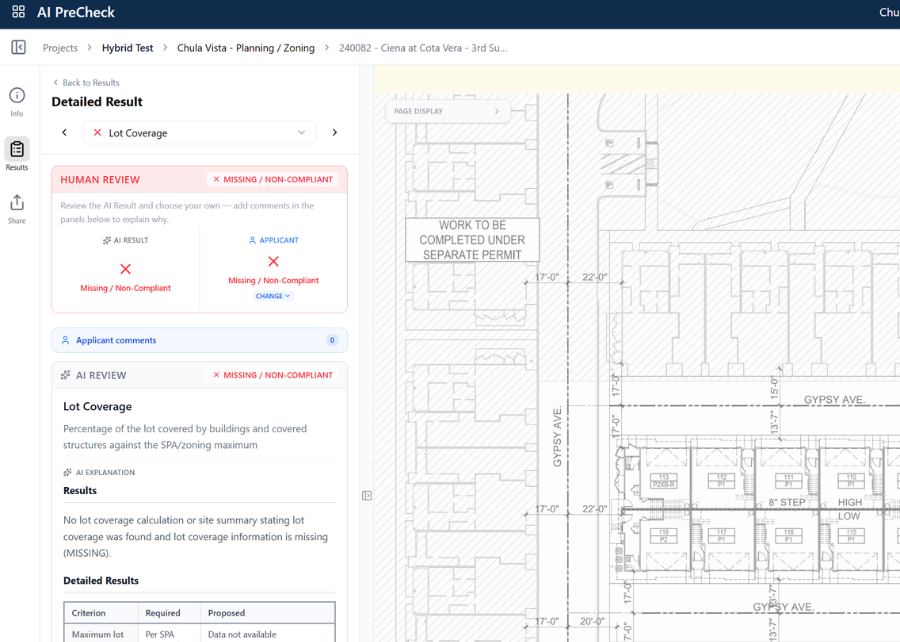
An AI PreCheck platform report of noncompliant lot coverage
What the Data Reveals
Accuracy matters because it means our system is picking up on things that humans are missing. For example, we ran a 172-page construction document through our Completeness Check module within AI PreCheck, and within three minutes, it revealed that the document was missing boundary setback dimensions.
If you had to pay me as a draftsman (which I used to be) to check that giant set of drawings, it would have taken me the best part of two days to manually go through a checklist and markup the plans with a red pen.
Our system picked up everything in two minutes and prevented the document from being rejected by the city.
To put this in perspective: If I, as an applicant, send my submission to a city and don’t hear anything for six months, until one day it’s rejected because I didn’t include a dimension on something, I’m going to be upset. Meanwhile, the plan reviewer might look at the submission and say, “How could he have forgotten that?” Everyone is frustrated.
We prevent a lot of that frustration with help from battle-tested, explainable AI. But we’re not just doing it to speed things up. We’re also uncovering insights that can help cities and counties improve their own processes and even inform policy changes.
With all the plan checking our systems have done to date, we now have statistics about which rules people fail on consistently. During the first week working with Los Angeles, we identified a rule about indicating mature trees on plans. In one set of 38 submissions, 58% failed for not having enough trees, and those applications were blocked. When we showed that to the city, they said, “Wow, we didn’t know that would be an issue,” and they addressed it.
Meanwhile, I was recently working in another city’s platform, and I got confused about a rule requiring a certain setback for blocks of land identified as “creek blocks.” The reports were telling us that people were repeatedly getting rejected for that rule. I asked about it, and the city said, “[So-and-so] put that rule in place four years ago, and he doesn’t even work here anymore.” So, they did an update to the zoning ordinance and took out the rule.
Insights like these help municipalities make policy changes and educate applicants. We’re not just making things faster. We’re making it better overall for the building industry and municipalities.
The real promise of AI in permitting isn’t automation. It’s understanding. With systems that truly understand buildings, regulations, and patterns at scale, they don’t just accelerate approvals, they help architects, developers, homeowners, contractors, and local governments build better places for everyone to live.